
Chairman Speech at Real Estate Market Outlook (REMO) 2026 Conference
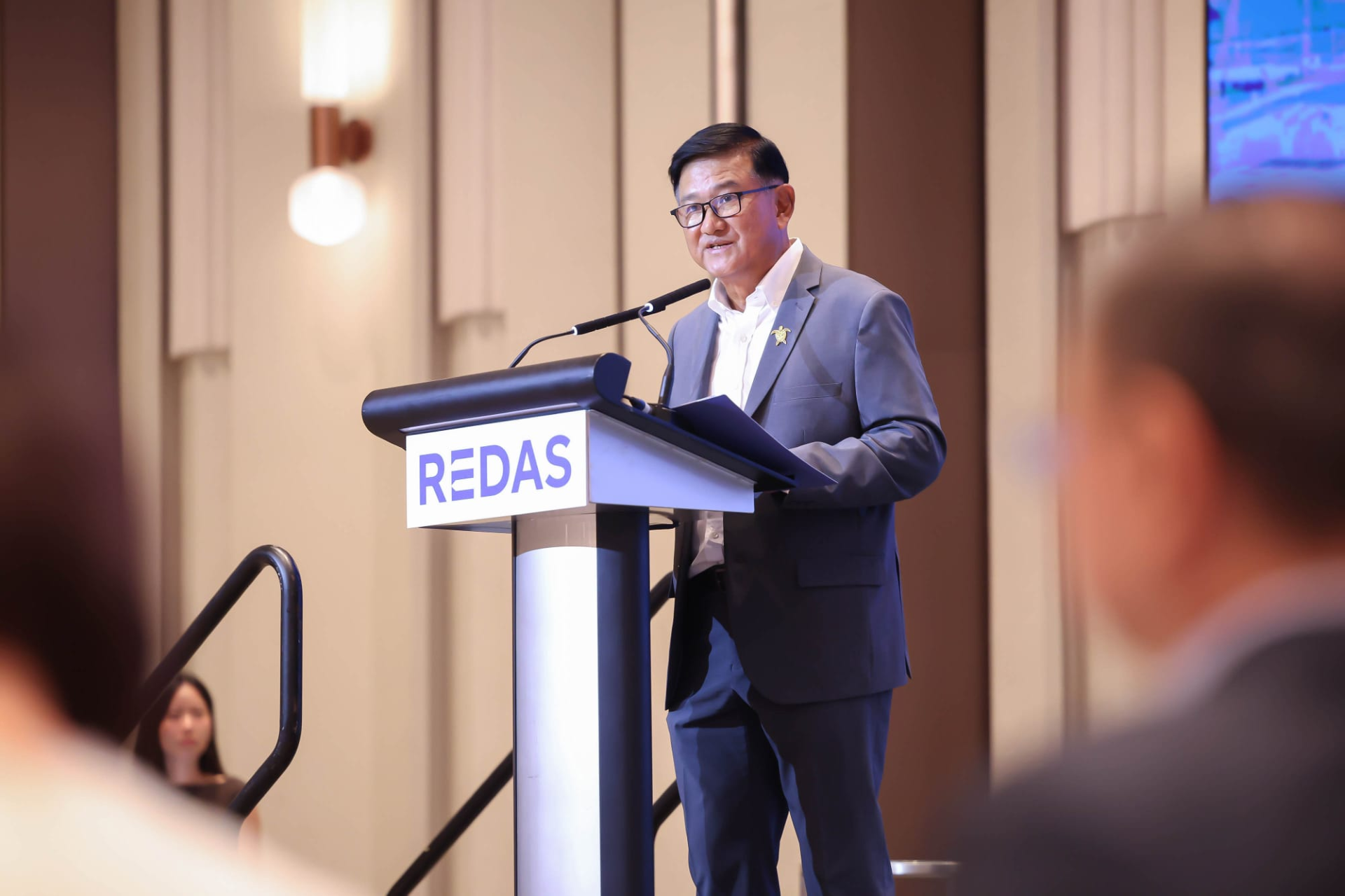
SPEECH BY MR. ROY CHIANG
Chairman, Employment and Employability Institute.
Real Estate Market Outlook (REMO) 2026 Conference, 15 July 2026 at Grand Copthorne Waterfront Hotel
Good morning. President of REDAS, Mr Tan Swee Yiow, Distinguished guests, ladies and gentlemen, it is a great pleasure to join all of you this morning.
Whenever visitors arrive in Singapore, the first thing they encounter is our world class airport and the next thing they see is our very visible skyline – the Marina Bay area, our business district or even our housing estates. These are built from concrete, steel and glass, and it reflects our ambition, our confidence and our progress.
Together, they tell the story of a nation that has transformed itself in just one generation.
But, as part of this story, there is something else that remains a little less visible. It is our ideas, skills, leadership and values. It is our people.
This less visible factor is far more important because while buildings define a city’s landscape…People determine its future.
And that is what I would like to speak about this morning. Not buildings. Not capital. Not market cycles. But people.
Real estate has never really been about buildings alone. It has always been about people also. Every successful development begins with someone’s imagination. Every thriving precinct is the result of thousands of professionals working together to create places where people want to live, work and play. Buildings may receive recognition, but it is the people who create their value.
Singapore is not blessed with abundant land nor vast natural resources as we all know. Neither have we competed by being the lowest-cost economy. Instead, generation after generation, we have invested in education, skills and institutions.
We have developed people who could solve increasingly complex problems. And that has transformed us from a small trading port into one of the world’s most competitive cities.
That same philosophy must guide our real estate sector.
Because the next chapter of Singapore’s development will be very different from the last.
For many decades, our challenge was to build, to create homes, workplaces and city infrastructure. To give a young nation the foundations it needed to grow.
Today, our challenge is no longer simply that. We have to build better, to renew ageing precincts, to retrofit existing buildings and to create greener and smarter buildings.
And that is a much more complex challenge.
In the real estate sector, success today is also no longer measured only by how well a project is managed or whether it generates great returns. Increasingly, it is measured by whether a building remains adaptable? Consume less energy? Embrace new technologies? And whether it continue creating value for owners, tenants and the wider community. These questions cannot be answered by engineering, finance or technology alone. They need something more – People working together across disciplines.
Every generation believes it is living through unprecedented change. Perhaps for the first time, that statement is actually true.
Artificial Intelligence is transforming how we design buildings. Digital twins are changing how we operate them. Automation is changing how work is performed. Sustainability is changing how investments are evaluated. And customer expectations are changing faster than ever before. Almost every assumption that shaped our industry twenty years ago is being challenged.
That can feel unsettling, but it should also excite us. And those who cope best will not necessarily be those with the biggest balance sheets, the largest land banks or even the newest technologies. They will be those that can learn the fastest and those who acknowledged that although technology changes what is possible, it is People who determine what becomes possible.
That is why I believe the conversation about technology must always begin with a conversation about talent.
If people are the foundation of our future, then we must confront a reality that every business leader will face. We are no longer competing only for projects, investment or market share. We are competing for talent. And across every sector of our economy, companies are searching for the very same talent. And this, amidst our aging population and shrinking local talent pool. Hence, the traditional method of recruiting is not the best way forward anymore.
Our future challenge will not be on building attractive developments anymore. It will depend on building attractive careers. So, we have to tell a much more compelling story about what modern real estate has become. And hopefully, this will become a strong magnet for talent.
Perhaps nowhere is work transformation more evident in the real estate sector than in the field of Facilities Management – a large employer of people in this sector.
For many years, Facilities Management has been viewed as a support function – necessary but largely invisible. Today, Facilities Management sits at the heart of asset performance. It is strategy capability. If construction creates assets, Facilities Management protects its value.
An “A” Grade office tower may attract tenants because of its location or architecture. But tenants stay because the building performs consistently, day after day. And this through facilities managers managing intelligent building systems, optimising energy consumption and interpreting live operational data to predict equipment failures, hence improving the experiences of occupants and even contributing directly to ESG outcomes.
In many ways, Facilities Management has become one of the most technology-enabled professions within the Built Environment. Yet public perception has not always kept pace.
This brings me to an important point. Technology, by itself, has never transformed an organisation. People do.
That belief lies at the heart of e2i’s work. e2i as in Employment and Employability Institute of Singapore. Many organisations know e2i for our training programmes or employment services. But increasingly, our role begins much earlier.
We work with businesses as they rethink how work is organised. How jobs can be redesigned. How talent can be developed by complementing technology with people and how its leadership can prepare their workforce for the future.
Over the years, the NTUC Company Training Committee and CTC Grant have seen how construction companies across the Built Environment have adopted digital platforms that improve collaboration and productivity by enabling employees to focus on higher-value work. As of Apr 2026, e2i has partnered 3800 companies through the CTC Grant steering 15,000 workers into higher value jobs. That is the future we should all strive for.
As I look around this room today, I see many leaders who have helped shape modern Singapore. You have transformed reclaimed land into thriving business districts. You have built homes for generations of Singaporeans. You have created offices that attracted global businesses, hotels that welcome the world, and developments that have become landmarks in their own right.
But I would suggest that the next chapter of Singapore’s success will not be defined by the next iconic building. It will be defined by whether we continue to build organisations that can learn, adapt and innovate faster than the world around us. Because the source of competitive advantage is changing. In the past, we have competed through capital or scale. Today, we need to compete through people.
As leaders, we often spend considerable time discussing investments. We debate acquisitions. We approve capital expenditure. We evaluate returns on assets. These are all important decisions.
But perhaps the most important investment any leader can make this year will never appear on the balance sheet. It is the investment we make in our people because the capabilities we develop in them will continue to compound and generate returns for years to come.
This is where REDAS has an important role to play.
For more than six decades, REDAS has helped shape the growth of Singapore’s real estate industry. It has brought together stakeholders to solve common challenges and raise professional standards. That role is now more important than ever.
Because while companies compete in the marketplace, we all share common interests – A stronger talent pipeline. Higher professional standards. A more innovative industry and a workforce equipped for the future. No single organisation can achieve these outcomes alone. We need partnerships.
That is why I encourage every organisation here today to think of e2i not simply as a provider of programmes, but as a partner in your transformation. Whether you are redesigning jobs, preparing leaders, strengthening digital capabilities or building a pipeline of future talent, you do not have to undertake that journey alone.
But before you start this journey, I think you need to answer 3 simple questions.
Not questions for your HR department, but for every leader or CEO here today.
First.
Five years from now, what capabilities will define the winners in your industry?
Not what projects. Not what technologies. But what capabilities?
Second.
Are you building those capabilities today?
Or are you hoping that the talent you need will somehow appear when you need it?
Because hope is not a strategy.
And finally.
If people are truly your greatest competitive advantage, are you investing in them with the same discipline, commitment and urgency that you invest in your physical assets?
If the answers are “not yet”… Then perhaps that is where your transformation journey should begin.
At the beginning of my speech, I suggested that Singapore has a very visible skyline that is remarkable. It tells the story of our ambition and economic success.
But it is the invisible, that is even more remarkable. It is the people who dreamt, who designed, who built, who managed, who maintained and who innovated. And those who never stop learning. So, let us not lose sight of what is important for the way ahead.
Technology will continue to evolve. Markets will continue to fluctuate. Business models will continue to change, and buildings will eventually be torn down and renewed.
But a nation that continues to develop its people will always renew itself. And that has been our Singapore’s story for the past sixty years.
But it must also be our story for the next sixty. So let us continue to build world-class developments, continue to create greener and smarter cities and continue to embrace innovation. But above all…let us continue to develop our people.
Because the finest legacy we can leave behind is not simply a skyline admired around the world, it is a generation of people who are capable of building an even better one.
Smart and beautiful buildings may define our city. But people will define our future.
Together, let us build both.
Thank you very much, and I wish you all a fruitful and inspiring conference ahead.
